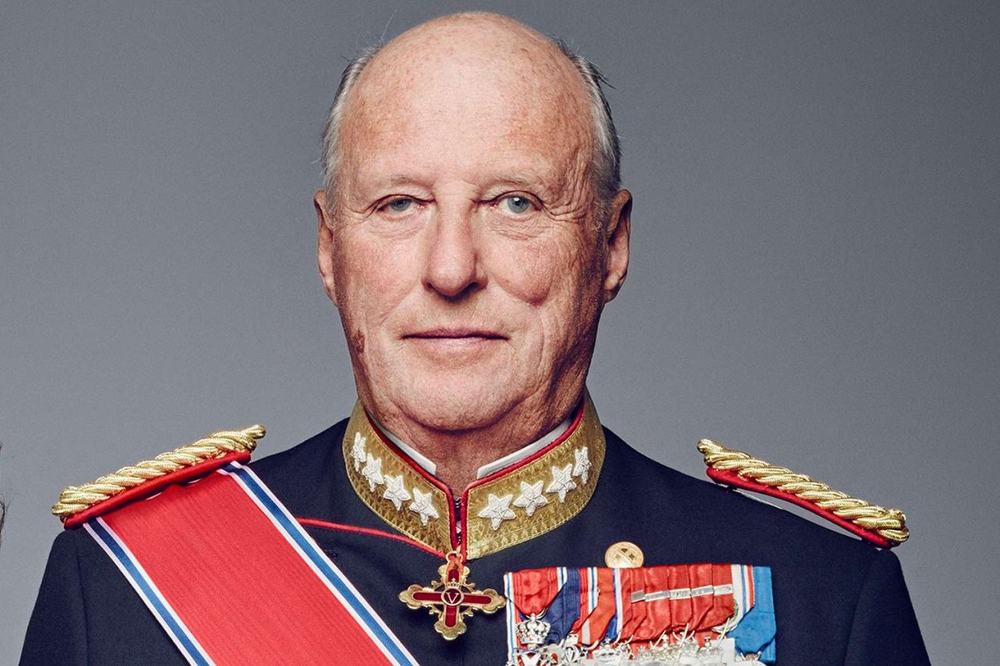
Bønn og puja seremoni for H.M. Kong Harald V og flomofrene i Nepal og Tibet
Lama Changchub ledet bønn og puja seremoni på KTL søndag 30.8. Les talen her:
I forbindelse med Kong Harald V sin bortgang, og med de tragiske naturkatastrofene som skjedde denne uka i Nepal og Tibet , ledet Lama Changchub oss i bønn og puja-seremoni. Rund 30 personer deltok på Karma Tashi Ling buddhistsenter, søndag 30. august kl. 18.00.
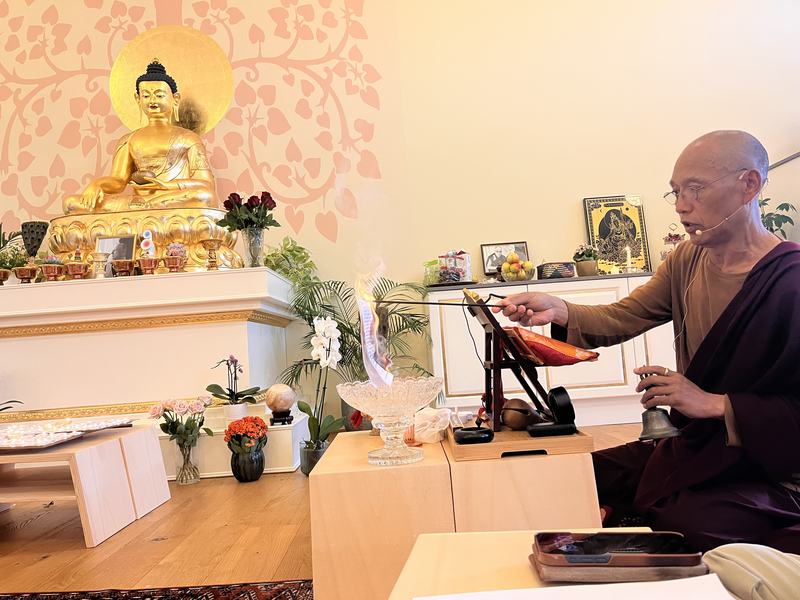
Her kan du lese Lama Changchubs tale:
THE ELEPHANT'S FOOTPRINT
Dear Dharma friends,
Thank you for coming today.
We have gathered here for prayers and puja at a very poignant moment. Normally, when we gather together, we may come because there is something to celebrate. Today, we come because there is something to remember. Something to mourn. And perhaps, most importantly, something to wake up to.
We have come together with two profound tragedies in our hearts. Here in Norway, we mourn the passing of our beloved King Harald V, who passed away on 28 August at the age of 89. For many people in Norway, King Harald was not simply a king in a constitutional or historical sense. He was part of the landscape of our lives. For decades, he was simply there. We saw him grow older. We saw him carry the responsibilities of his position. We saw him at moments of national celebration, and at moments when the country itself was grieving.
And now he is gone.
At the same time, our hearts are turning toward the Himalayas, toward the border regions of Tibet and Nepal, where a sudden glacial collapse and devastating flash flood have brought enormous suffering. Hundreds have died. Thousands are missing. Families are searching. Homes and villages have been destroyed. Roads and bridges have disappeared. And many people are waiting without knowing whether the person they love is alive or dead.
So today we pray.
We pray for King Harald. We pray for those who have died. We pray for those who are missing. We pray for their families. We pray for those working in rescue and relief. And we pray for ourselves.
Because whenever death and suffering come so close to us, they ask a very uncomfortable question: How are we living?
The Buddha gave us a very simple teaching. He said: "Among all footprints, the elephant's is the largest. Among all perceptions, the best perception is that of impermanence." The elephant's footprint is enormous. You cannot miss it. You don't need to be a great spiritual master to recognise that an elephant has been walking through the neighbourhood. And the Buddha is telling us: Among all the things we can perceive, impermanence leaves the deepest footprint.
Everything changes. Everything moves. Everything that comes together eventually comes apart. But we spend an extraordinary amount of our lives pretending that this is not happening.
We make plans. We build houses. We accumulate things. We establish institutions. We develop our careers. We become attached to our opinions. We become attached to our identities. And then impermanence comes along and says: "Excuse me. I was here before you."
And it doesn't matter whether you are a king or a beggar. It doesn't matter whether you live in a palace or a small apartment. It doesn't matter whether you are famous or completely unknown. Impermanence does not discriminate. And strangely enough, that is good news. Because impermanence is not merely the thing that takes everything away. It is also what makes everything precious.
There is a beautiful story of Kisa Gotami. Her young child died. She was completely devastated. She could not accept the death. She carried her dead child from house to house, looking for medicine, looking for someone who could bring him back to life.
Finally, someone told her:"Go see the Buddha." So she went to the Buddha and asked him to save her child. The Buddha looked at her and said: "Yes, I can help you. But first, bring me a mustard seed." She was relieved. A mustard seed? That should not be difficult.
But then the Buddha said: "The mustard seed must come from a household where nobody has ever died." So she went from house to house. –"Do you have a mustard seed?" –"Yes."
–"Has anyone in this household ever died?" –"Yes."
She went to another house. Again, a mustard seed. Again, someone had died. Another house. Another family. Another story of loss. And slowly, something began to happen. She discovered that death was not her private tragedy. Every household knew suffering. Every family had experienced separation. Every human being was living under the same law. And eventually she understood. She could not bring her child back. But she could wake up.
This is a very profound point. The Buddha did not remove her grief. He transformed her relationship to grief. As my retreat master often emphasised in presenting this story, she did not simply hear the teaching of impermanence. She encountered it directly. She walked through the village. She saw it. And when impermanence moved from an idea into direct experience, something changed in her mind. This is the difference between knowing Dharma and seeing Dharma.
We can say: "Everything is impermanent." Very good. We can say: "Everything arises and passes away." Very good. We can say it in Tibetan, and somehow it sounds even more profound. But then somebody we love dies. And suddenly we say: "Yes, yes, everything is impermanent—but not this person." We want an exception. We want a small private agreement with samsara. "Everything else can change, but please leave my family alone."
Unfortunately, samsara does not negotiate. Death does not check our calendar. Impermanence does not make an appointment. And the glacier does not send us an email saying: "I am terribly sorry, but I am about to collapse next Tuesday afternoon." It simply happens. And that is precisely why the Dharma says: Wake up.
This is also why I think of Milarepa. Milarepa's songs about impermanence and death have something wonderfully raw about them. He doesn't decorate death. He doesn't make it polite.
He doesn't say: "Don't worry, everything will be comfortable." He looks directly at death. And his message is something like: You are going to die. So what are you doing with your life?
That is a very good question. And perhaps not a very comfortable one. Because we waste an enormous amount of our life. We postpone. "I'll practise tomorrow." "I'll forgive tomorrow."
"I'll call my friend tomorrow." "I'll become more compassionate when I have more time."
But tomorrow is an idea. This moment is real. Milarepa understood this. He looked at the mountains and saw the teaching everywhere. Snow falls. Snow melts. Clouds gather. Clouds disappear. Rivers rise. Rivers fall. The body is born. The body grows old. The body becomes sick. The body dies. This is not a mistake in the system. This is the system. And when we understand that, we begin to live differently.
This brings us naturally to what we call in Tibetan Buddhism the Four Reminders,
or the Four Thoughts That Turn the Mind Toward Dharma.
These are not four gloomy Buddhist ideas. They are four ways of waking ourselves up.
The first is the precious human birth. We have been given this extraordinary opportunity. We can think. We can love. We can practise. We can hear Dharma. We can help another person. We can develop wisdom and compassion. But this opportunity is not permanent. So the first reminder says: This life is precious. Do not waste it. We don't need to become perfect. But we should make our life meaningful.
The second reminder is impermanence and death. Everything changes. Death is certain. But the time of death is uncertain. King Harald's passing reminds us of this. The tragedy in the Himalayas reminds us of this. And our own lives remind us of this every morning when we wake up.
The third reminder is karma—the law of cause and effect. What we do matters. What we say matters. What we think matters. Our actions leave traces. If we cultivate hatred, hatred grows. If we cultivate greed, greed grows. If we cultivate kindness, kindness grows. So when we are confronted with suffering, we should ask: What am I planting? What am I putting into the world? Am I contributing more fear? More division? More anger? Or am I contributing patience, kindness, courage and compassion?
And the fourth reminder is the suffering and unsatisfactory nature of samsara.
Samsara promises: "Just get a little more, and then you'll finally be happy." So we get a little more. And then we need a little more. And then a little more. And eventually we discover that we have spent our whole life chasing the next thing. Samsara is a very clever salesman. It keeps saying: "Happiness is just around the corner." And we keep buying the product.
The Four Reminders interrupt that advertisement. They say: Look carefully. This life is precious. It is impermanent. Your actions have consequences. And conditioned existence cannot provide lasting security.
Therefore: Turn toward Dharma.
But now we come to something deeper. Because Buddhism does not stop with impermanence. We have to look at relative reality and ultimate reality. On the relative level, birth happens. Death happens. People are born. People die. King Harald was born. King Harald lived. King Harald died. People were born in the Himalayan villages. People lived there. People have now died. Families are grieving. This is relative reality. And we must honour it. If someone is crying because they have lost a loved one, it is not compassionate to say: "Don't worry. Ultimately there is no birth and no death." That may be an expression of ultimate truth. But if you say it to a grieving mother, you may discover that your enlightenment needs a little more compassion. We must not use ultimate truth to escape relative truth. We bow to grief. We acknowledge death. We offer prayers. We help where we can. This is compassion.
But then Buddhism asks us to look more deeply.
At the level of ultimate reality, there is no inherently existing birth. And therefore, ultimately, there is no inherently existing death. Why? Because nothing exists independently, permanently, from its own side. Everything arises through causes and conditions. Everything appears. Everything changes. Everything dissolves. But when we search for some solid, independent entity that is being born and then dying, we cannot find it. The ultimate nature of phenomena is unborn. And what is unborn does not ultimately die. This does not mean that death is unreal in the ordinary sense. It means that our ordinary concepts of "birth" and "death" do not capture the ultimate nature of reality. And this is where wisdom and compassion meet.
If we hold only relative truth, we may drown in grief. If we hold only ultimate truth, we may become cold. The Dharma asks us to hold both. On the relative level: grieve. On the ultimate level: reckognise emptiness.
On the relative level: care for beings. On the ultimate level: reckognise that there is no separate, permanent self.
On the relative level: practise compassion. On the ultimate level: rest in the unborn nature of mind.
This is not a contradiction. This is the path.
Think of a wave. A wave rises from the ocean. We say: "The wave has been born." The wave rises higher. Then it falls. We say: "The wave has died." But where did the wave actually come from? It did not come from somewhere outside the ocean. And where did it go? It did not go somewhere outside the ocean.The wave has a relative appearance. We can see it. We can name it. We can even become very attached to it. But its nature is water.In the same way, we are like waves. King Harald was a wave. The people who have died in the Himalayas were waves. You are a wave. I am a wave. We arise. We appear. We have names. We have histories. We love. We suffer. We laugh.We cry.And eventually the particular form changes.
But the ultimate nature of reality is not captured by our concepts of coming and going.
This is why the great masters could look at death without fear. They were not denying death. They had looked deeply into its nature.
So today, dear friends, let us hold these teachings together.
Let us not become philosophical at the expense of being human.
Let us grieve. Let us remember King Harald with gratitude and respect.
Let us pray for the people who have died in the Himalayan disaster.
Let us pray for those who are missing.
Let us pray for their families.
Let us pray for those who are searching and rescuing.
Let us pray for those whose homes and livelihoods have been destroyed.
And let us also remember the Four Reminders.
This human life is precious.
So let us use it well.
Everything is impermanent.
So let us not waste our time.
Karma is infallible.
So let us be careful about what we create with body, speech and mind.
Samsara is incapable of giving lasting satisfaction.
So let us turn our minds toward liberation.
And let us remember the deeper truth:
Ultimately, phenomena are unborn.
Therefore, ultimately, there is no birth and no death.
---
Perhaps the greatest way to honour the dead is not simply to mourn them.
It is to live more awake because they have died.
If the death of King Harald makes us appreciate the preciousness of our own life, then something meaningful has come from our grief.
If the tragedy in Nepal and Tibet makes us more compassionate toward people we will never meet, then our hearts have become larger.
If impermanence makes us forgive someone we have been angry with for ten years, then the elephant has left a footprint.
If death makes us stop wasting our life on unnecessary arguments, then the teaching has entered our bones.
This is Dharma.
Not merely understanding impermanence.
But living differently because we understand it.
---
And perhaps we can make one small commitment today.
When you leave this temple, remember impermanence.
When someone irritates you, remember impermanence.
When you are angry, remember impermanence.
When you are worried about something that seems enormously important, remember impermanence.
And when you are happy— especially when you are happy— remember impermanence.
Don't try to hold happiness. Appreciate it. Enjoy it. Share it. And let it go.
That is freedom.
---
Dear Dharma friends,
Today we are praying for the dead. But we are also praying for the living. Because one day, someone will gather and pray for us. We don't know when. We don't know how.But we know that this life is moving in that direction. So let us not be frightened by that knowledge. Let us be awakened by it. Let us become a little kinder. A little more patient. A little less self-important. A little more willing to listen. A little more willing to forgive. A little more courageous in facing suffering. And a little more devoted to the practice of Dharma. Because the real puja does not end when the chanting ends. The real puja begins when we walk out of this room and meet the world again. Can we carry compassion with us? Can we carry wakefulness with us? Can we carry the understanding of impermanence with us? Can we look at another human being and recognise: This person, too, is temporary. And therefore: This person is precious.
---
So now, as we begin our prayers, let us bring all of this into the practice.
May the consciousness of His Majesty King Harald V be guided toward peace, clarity and liberation.
May all those who have died in the Himalayan catastrophe be free from fear and confusion and find favourable conditions for awakening.
May those who are missing be found.
May those who are injured receive care.
May those who are grieving receive strength and support.
May the rescue workers be protected.
May the relief efforts succeed.
May the suffering of all beings become a doorway to compassion and wisdom.
May loving-kindness spread without boundary.
May compassion arise without discrimination.
May wisdom illuminate our minds.
And may the merit of our prayers benefit not only those whom we remember today, but all beings everywhere. The dead. The living. Those who are suffering. Those who are forgotten. Those we love. Those we find difficult to love. All of them.
May all beings be free from suffering and the causes of suffering.
May all beings find happiness and the causes of happiness.
May all beings awaken to their true nature.
And may we ourselves have the courage to wake up while we are still alive.
The elephant has left its footprint. We have seen it. Now let us not forget. Let us pray together.
Let us breathe together. Let us dedicate together. And then let us go back into the world— a little more awake, a little more tender, and a little more compassionate.
Thank you.
-Lama Changchub Tsering
